
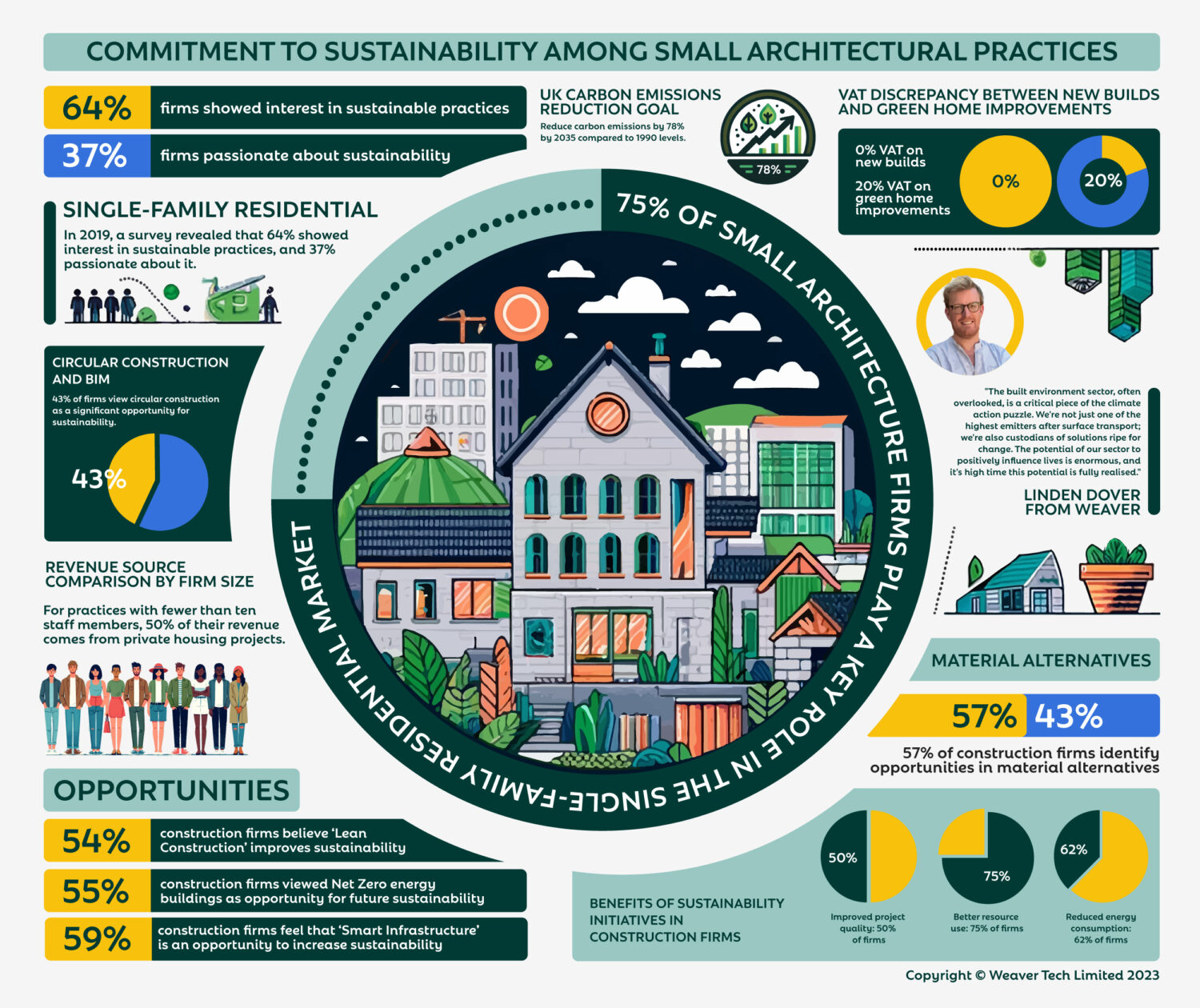
Weaver, the online platform that introduces contractors to architects, join forces with UK architects to spearhead a sustainable revolution, addressing rising costs, VAT issues, and material challenges in line with carbon neutrality goals, championing COP28 policy reforms and industry education to reshape the nation’s architectural future.
Weaver launched a vital study involving the UK’s small residential architecture firms, assessing the practicality of meeting COP28’s bold environmental targets by 2030. This initiative highlights Weaver’s dedication to sustainable innovation and its leading role in driving the UK’s architectural sector towards a greener future.
“The built environment sector, often overlooked, is a critical piece of the climate action puzzle. We’re not just one of the highest emitters after surface transport; we’re also custodians of solutions ripe for change. The potential of our sector to positively influence lives is enormous, and it’s high time this potential is fully realised.” says Linden Dover from Weaver.
COP28
On ‘Built Environment Day’ (6 Dec 2023) at COP28, the UK Green Building Council (UKGBC) has published new insight revealing the built environment industry is significantly off-track from the trajectory required to meet the UK’s national net zero commitments.
Commenting on these findings Smith Mordak, Chief Executive at UKGBC: “Unprecedented global events have shaped the story of the built environment over the last 4 years, but despite forced emissions reductions during the pandemic, this progress report makes one thing clear: our industry is not moving fast enough.” [6]
Weaver Interviews with UK Architects
In the evolving world of architecture, a significant shift towards sustainability and ecological practices is evident among the UK’s small architectural practices. These architects are increasingly committed to integrating environmental considerations into their designs. The emphasis is on creating buildings that not only serve human needs but also positively contribute to the environment, enhancing biodiversity and reducing ecological footprints.
- For practices with fewer than ten staff members, 50% of their revenue comes from private housing projects, indicating a strong focus on residential projects. This is in contrast to larger firms where the revenue sources are more diversified. [1]
- Approx 75% of architecture firms, particularly with ten or fewer employees, play a key role in the single-family residential market. In 2019, a survey revealed that 64% showed interest in sustainable practices, and 37% passionate about it. Despite this interest, many firms haven’t signed the 2030 Commitment or established sustainability action plans, but half report frequent discussions with clients about environmental impacts. [2]
Davide di Martino, Founder of Unagru and NoMoreGas.org explains “The grid in the UK is rapidly decarbonising so the emissions coming from electricity production is falling. This means that [electric] alternatives to gas boilers are more eco-friendly. It used to be that electric alternatives would use electricity on site, but then that electricity was produced by a very carbon-intensive grid. Therefore, the two alternatives were not that different, whereas the grid is decarbonising very quickly. The [combined emissions] of all the gas boilers in the UK (17million), are much higher than the combination of all the UK’s power plants.”
Viktor Westerdahl, Director of Westerdahl explains “I’ve tried to push [sustainability] in every project. I think the challenge really is when you come up against the cold, hard reality of budget, then people often scale back on those ambitions. It can be really small things like you might have an air-to-air heat exchange in a bathroom and it’s cheaper to just put in a normal one. What I do try to bake in is putting good insulation in, because you have to put that anyway and it’s not so much more expensive.”
- A lack of regulation and public awareness around sustainable design poses a challenge. Sustainable materials and technologies are often more expensive than traditional options, making it difficult to persuade clients to agree to green designs. [3]
Weaver, the online platform that introduces contractors to architects, supports architects with this pledge. As we’re amidst the COP28 summit, it’s crucial to acknowledge the significance of this moment. This summit is more than a gathering; it’s a critical global platform that transcends national borders, rallying us around urgent environmental issues. In the thick of challenges and debates, we must recognise our collective responsibility to drive meaningful change.
Challenges and Innovations
However, the path to sustainable architecture is not without its challenges. Small practices often grapple with the high costs associated with sustainable materials and methods. Additionally, the task of educating both clients and builders about the benefits and necessity of sustainable practices remains a significant hurdle. There is a pressing need for a wider understanding and acceptance of sustainable architecture principles in the broader construction industry.
- 3 out of 4 construction firms report that sustainability initiatives have led to better resource use, including designing less material-intensive assets and minimizing waste. These initiatives also translate to reduced energy consumption (62%) and improved project quality (50%). [4]
- 54% of construction firms see lean construction as a promising area for increasing sustainability in the next two years. Other areas of opportunity include material alternatives (57%), net zero energy buildings (55%), and smart infrastructure (59%). [4]
Despite these challenges, architects are developing innovative solutions to meet sustainable goals. These include the use of natural materials, like wood fibre insulation and lime plaster, and techniques that improve a building’s energy efficiency. Architects are focusing on the long-term benefits of such materials, despite their higher initial costs and complex installation processes, underscoring a commitment to more environmentally responsible building practices.
“I found out when I was studying retrofitting that the use of wood fibre insulation was found to work best with period properties, and the best results had been with wood fibre or cork. They’d put monitors between the brick wall and the wood fibre and they were able to monitor the effect of this over a number of years and see if there were any problems with moisture” explains Natalie Black, Founder of Enbee Architecture and Design. “Made out of a grown material, it’s absorbing carbon when it’s growing, you put it into the building and carbon in that material is then locked into the building for the duration of its time in the building.”
- 43% of firms view circular construction as a significant opportunity for increasing sustainability, with Building Information Modeling (BIM) playing a vital role in this process. [4]
The Role of Government and COP28 Policies
The architects also call for more robust government policies and incentives to support sustainable architecture. A key point of discussion is the disparity in VAT between new builds (zero-rated) and refurbishments (subject to 20% VAT). This discrepancy discourages the retrofitting of existing buildings, a practice crucial for environmental sustainability. The architects advocate for policy changes that encourage sustainable practices, particularly in the refurbishment sector.
“There’s probably a wider discussion about this country’s economy and the desire for house prices to continue to rise at 5-7% a year. I think the government needs to do more to counteract the negative stories in the press, particularly for heat pumps. There’s lots of misinformation out there. You know, we have to get rid of gas. We have to stop using gas boilers. We have to decarbonize.” John Stack, Partner at North Architects
- Until recently, there was no VAT on new builds, but the rate of VAT on green home improvements was set at 20%, discouraging the retrofitting of existing buildings. However, in 2023, the UK government announced they will scrap VAT on green home improvements for the next five years, aligning with their commitment to reduce carbon emissions by 78% by 2035 compared to 1990 levels. [5]
Architect Gavin Hegarty addresses the discrepancy in VAT “It’s just it doesn’t make sense that there’s a 0% rating on knocking down a building that’s going to cost 20% more to refurbish. It just makes zero sense. And that really has to change at policy level.”
There is a consensus on the need for widespread education within the industry. From architects to builders, increasing the knowledge base around sustainable practices is seen as vital. Courses like the Passive House Designer course are highlighted as valuable resources for professionals seeking to deepen their understanding of sustainable architecture. The industry is encouraged to engage in continuous learning and adaptation to meet the challenges of sustainable building design head-on.
The path to sustainable architecture, while challenging, is filled with opportunities. With substantial investment, technological advancements, and supportive government policies, the UK is on the right track to achieve its ambitious carbon neutrality target by 2050.
Sources
[2] https://www.buildinggreen.com/blog/how-smaller-architecture-firms-are-adopting-sustainable-design
[3] https://www.buildpass.co.uk/blog/architectural-challenges-in-the-face-of-the-climate-crisis/
[4] https://constructionblog.autodesk.com/sustainable-construction-statistics/
[5] https://architectureforlondon.com/news/vat-on-green-home-improvements/